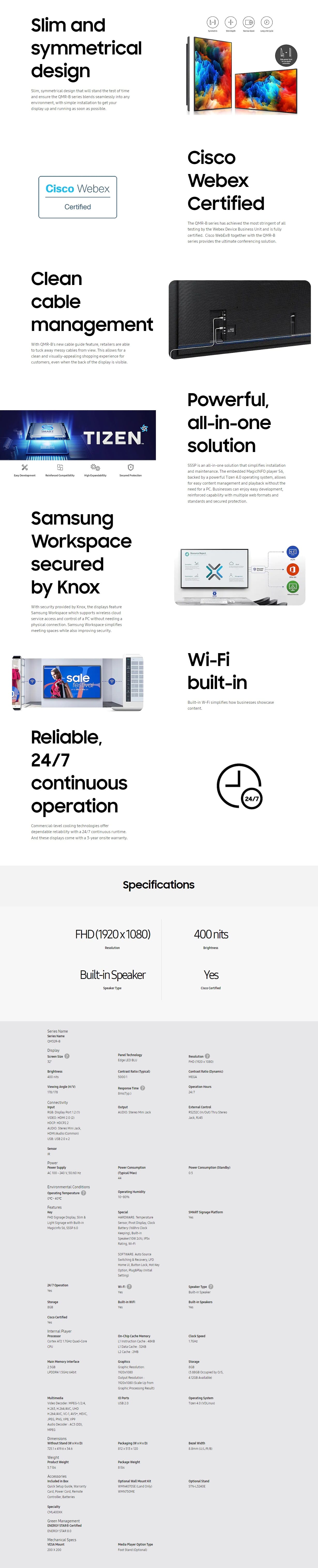
LED backlighting type
Backlighting is the illumination of a screen e.g. LCD (liquid crystal display). There are several types of backlighting with LEDs, e.g. full array, edge lit.
Edge-LED BLU
Display diagonal
Size of the display for this product, measured diagonally, usually in inches.
81.3 cm (32")
Display technology
The technology used in the display e.g. plasma, LED.
LED
Display resolution
The number of distinct pixels in each dimension that can be displayed. It is usually quoted as width × height, with the units in pixels: for example, "1024 × 768" means the width is 1024 pixels and the height is 768 pixels. The higher the number of pixels, the sharper the image.
1920 x 1080 pixels
Display brightness
Brightness is the amount of radiating light emitted from the screen. The brightness rating is measured in candellas per square meter, commonly known as 'nits'.
400 cd/m²
HD type
Type of supported High Definition (e.g. Full HD, 4K Ultra HD).
Full HD
Touchscreen
A screen of a laptop, smartphone, etc., that responds to touch so you can control the interface using your fingers.
Native aspect ratio
The aspect ratio is the ratio of the width of an image to its height. The native aspect ratio is the one which the projector/display is particularly designed for. Images shown in native aspect ratio will utilize the entire resolution of the display and achieve maximum brightness. Images shown in other than native aspect ratio will always have less resolution and less brightness than images shown in native aspect ratio.
16:9
Response time
The response time is the time difference between the moment that a source (for example a video card) sends a signal and that equipment (for example a monitor) receives or display the signal. (Used abbreviations: R/F = Rise and Fall.)
8 ms
Contrast ratio (typical)
The difference in light intensity between the brightest white and the darkest black.
5000:1
Dynamic contrast ratio marketing name
Mega Contrast
Viewing angle, horizontal
Maximum horizontal angle at which a display can be viewed with acceptable visual performance.
178°
Viewing angle, vertical
Maximum vertical angle at which a display can be viewed with acceptable visual performance.
178°
Display number of colours
1.07 billion colours
Pixel pitch
This is the parameter of a picture tube, which specifies the shortest distance between two dots of the same colour. The principle is: the smaller the dot pitch, the better sharpness of image.
0.36 x 0.36 mm
Active display area (W x H)
698.4 x 392.85 mm
Horizontal scan range
30 - 81 kHz
Vertical scan range
48 - 75 Hz
Haze rate
2%
Ports & interfaces
HDMI ports quantity
The number of sockets (ports) for HDMI connections. HDMI (High-Definition Multimedia Interface) is a compact audio/video interface for transferring uncompressed video data and compressed/uncompressed digital audio data from a HDMI-compliant device ("the source device") to a compatible computer monitor, video projector, digital television, or digital audio device. HDMI is a digital replacement for existing analog video standards.
2
HDMI version
2.0
HDMI input ports quantity
1
HDMI output ports quantity
1
DVI port
Digital Visual Interface (DVI) is a video display interface to connect a video source to a display device, such as a computer monitor.
DisplayPorts quantity
Number of DisplayPorts. A DisplayPort is a digital display interface developed by the Video Electronics Standards Association (VESA). The interface is primarily used to connect a video source to a display device such as a computer monitor, though it can also be used to carry audio, USB, and other forms of data.
1
DisplayPorts in
1
USB port
The device features a socket into which a USB cable can be plugged.
USB ports quantity
2
USB version
Universal Serial Bus (USB) is an industry standard developed in the mid-1990s that defines the interface used for connection, communication and power supply between computers and electronic devices. Every new version - for example 1.1, 2.0, 3.0 - is much faster than the previous one.
2.0
Wi-Fi
Popular technology that allows an electronic device to exchange data or connect to the internet wirelessly using radio waves.
RS-232C
Remote (IR) output
1
Audio
Built-in speaker(s)
The device contains speaker(s) to produce sound.
Number of built-in speakers
2
RMS rated power
RMS (Root mean square) is a measure of the continuous power required by a device, in particular audio amplifiers and loudspeakers.
20 W
Design
Placement supported
Where the product can be placed e.g. indoor/outdoor, horizontal/vertical.
Indoor
Product colour
The colour e.g. red, blue, green, black, white.
Black
VESA mounting
Panel mounting interface
The product can be used wih VESA mounting interfaces.
200 x 200 mm
Performance
Purpose
What the product is used for.
Universal
HDCP
High-bandwidth Digital Content Protection (HDCP) is a form of digital copy protection to prevent copying of digital audio and video content as it travels across connections.
HDCP version
2.2
Power
Power consumption (typical)
Amount of power consumed by this model, often expressed in watts (W). Typical values that manufacturers give are power consumption when off, standby/suspended mode, typical use, maximum usage.
44 W
Power consumption (sleep)
0.5 W
AC input voltage
The voltage of the AC electricity that is inputted into the product.
100 - 240 V
AC input frequency
50/60 Hz
Heat dissipation
The heat generated by the power supply.
245.5 BTU/h
Computer system
Computer system
Computer system type
System on Chip (SoC)
Built-in processor
Whether or not a processor is built into the device.
Processor frequency
The speed that the microprocessor executes each instruction or each vibration of the clock. The CPU requires a fixed number of clock ticks, or cycles, to execute each instruction. The faster the clocks rate, the faster the CPU, or the faster it can execute instructions. Clock Speeds are usually determined in MHz, 1 MHz representing 1 million cycles per second, or in GHz, 1 GHz representing 1 thousand million cycles per second. The higher the CPU speed, the better a computer will perform.
1.7 GHz
Processor cores
The number of central processing units ('cores') in a processor. Some processors have 1 core, others have 2 (e.g. Intel Core Duo) or more (e.g. the Intel Xeon E7-2850 has 10 cores).
4
Internal memory
A computer's memory which is directly accessible to the CPU.
2.5 GB
Internal storage capacity
The amount e.g of data which can be stored inside the device.
8 GB
Operating system installed
Type of operating system on a device e.g. IOS on Apple devices, Android for mobile devices.
Tizen 4.0
Weight & dimensions
Width
The measurement or extent of something from side to side.
725.1 mm
Depth
The distance from the front to the back of something.
34.6 mm
Height
The measurement of the product from head to foot or from base to top.
419.6 mm
Weight
Weight of the product without packaging (net weight). If possible, the net weight is given including standard accessories and supplies. Please note that sometimes the manufacturer leaves out the weight of accessories and/or supplies.
5.7 kg
Packaging data
Package width
The distance from one side of the packaging to the other.
812 mm
Package depth
The distance from the front to the back of the packaging.
120 mm
Package height
The distance from the top to the bottom of the packaging.
513 mm
Package weight
Weight of the packaged product.
8 kg
Operational conditions
Operating temperature (T-T)
The minimum and maximum temperatures at which the product can be safely operated.