Shipping Information
- Unavailable for shipping
- This product is not currently available for purchase
Store Availability
- Unavailable at Bankstown Store
- Unavailable at Castle Hill Store
- Unavailable at Northmead Store
Updated Intel Turbo Boost Max Technology 3.0; 48 PCI Express 3.0 Lanes; Intel Deep Learning Boost
| Processor | |
| Processor manufacturer The manufacturer that produced the processor. | Intel |
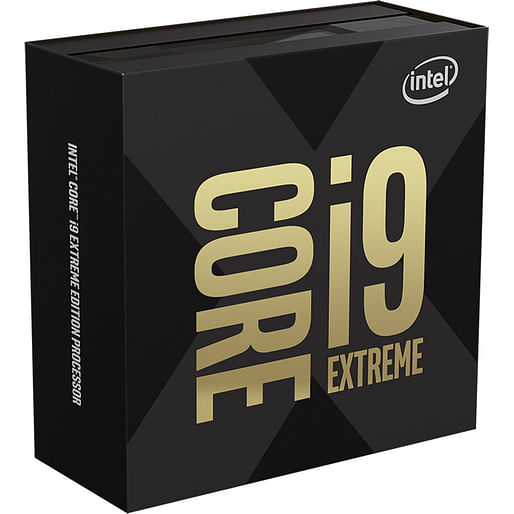
| Processor family A family of processors is a group of processors produced by one company over a short period of time e.g. Intel Pentium processors. | Intel® Core™ i9 X-series Extreme Edition |
| Processor frequency The speed that the microprocessor executes each instruction or each vibration of the clock. The CPU requires a fixed number of clock ticks, or cycles, to execute each instruction. The faster the clocks rate, the faster the CPU, or the faster it can execute instructions. Clock Speeds are usually determined in MHz, 1 MHz representing 1 million cycles per second, or in GHz, 1 GHz representing 1 thousand million cycles per second. The higher the CPU speed, the better a computer will perform. | 3 GHz |
| Processor cores The number of central processing units ('cores') in a processor. Some processors have 1 core, others have 2 (e.g. Intel Core Duo) or more (e.g. the Intel Xeon E7-2850 has 10 cores). | 18 |
| Processor socket Mechanical component(s) that provides mechanical and electrical connections between a microprocessor and a printed circuit board (PCB). This allows the processor to be replaced without soldering. | LGA 2066 |
| Component for What this product is used as a part of (component for). | PC |
| Processor lithography The process which is performed by the processor e.g. CPU (Central Processing Unit). | 14 nm |
| Processor model The model number for the processor in a computer. | i9-10980XE |
| Processor threads | 36 |
| Processor operating modes Operating modes for the processors that place restrictions on the type and scope of operations for certain processes run by the CPU. This design allows the operating system to run with more privileges than application software. | 64-bit |
| Processor cache | 24.75 MB |
| Box Plastic or metal shell/container for components. |
 |
| Cooler included The device comes with an integrated cooler. |
 |
| Processor boost frequency The turbo boost is an automatic, managed accelleration of the processor when one of the cores is overloaded. | 4.6 GHz |
| Processor codename | Cascade Lake |
| Generation | 10th Generation |
| Processor ARK ID | 198017 |
| Memory | |
| Maximum internal memory supported by processor | 256 GB |
| Memory types supported by processor | DDR4-SDRAM |
| Memory clock speeds supported by processor | 2933 MHz |
| Memory channels | Quad-channel |
| ECC ECC means Error Correction Code, and it is memory that is able to detect and correct some memory errors without user intervention. |
|
| Graphics | |
| On-board graphics adapter Graphics hardware which is built into the motherboard or CPU, as opposed to a separate graphics adapter (video card). On-board graphics uses CPU and RAM for graphics processing. |
|
| Discrete graphics adapter |
|
| On-board graphics adapter model "Graphic adapter" is the hardware that produces images on a display. "On-board" means that the graphics adapter is intergrated inside the motherboard. | Not available |
| Discrete graphics adapter model A graphics adapter (often known as a video card) generates images for a display. A discrete graphics adapter plugs into the motherboard, and usually produces much better graphics than an integrated graphics adapter. There are various models of discrete graphics adapters. | Not available |
| Power | |
| Thermal Design Power (TDP) | 165 W |
| Features | |
| Execute Disable Bit |
|
| Maximum number of PCI Express lanes | 48 |
| PCI Express slots version | 3.0 |
| Supported instruction sets | SSE4.1,SSE4.2,AVX 2.0,AVX-512 |
| Scalability | 1S |
| CPU configuration (max) | 1 |
| Embedded options available |
|
| Thermal solution specification Intel Reference Heat Sink specification for proper operation of this SKU. | PCG 2017X |
| PCI Express CEM revision | 3.0 |
| Harmonized System (HS) code | 8542310001 |
| Processor special features | |
| Intel® Hyper Threading Technology (Intel® HT Technology) <b>Improved Performance for Threaded Software</b> Intel® Hyper-Threading Technology (Intel® HT Technology) makes efficient use of processor resources, enabling multiple threads to run on each core and increasing processor throughput. Available on Intel® Core™ and Intel® Xeon® processors, Intel HT Technology helps run demanding applications simultaneously, protect and manage systems, and provide headroom for business growth. |
|
| Intel® Turbo Boost Technology <b>Higher Performance When You Need It Most</b> Intel® Turbo Boost Technology 2.0 accelerates processor and graphics performance by increasing the operating frequency when operating below specification limits. The maximum frequency varies depending on workload, hardware, software, and overall system configuration. | 2.0 |
| Intel® AES New Instructions (Intel® AES-NI) <b>Added Security with Faster Data Encryption</b> The Intel® Advanced Encryption Standard New Instructions (Intel® AES-NI) enable fast and secure data encryption and decryption for better performance and less risk from timing and cache-based attacks than table-based software implementations. Intel AES-NI supports usages such as standard key lengths, standard modes of operation, and even some nonstandard or future variants. |
|
| Enhanced Intel SpeedStep Technology |
|
| Intel 64 |
|
| Intel Virtualization Technology (VT-x) <b>Simplify Virtualization and Reduce Overheads</b> Intel® Virtualization Technology (Intel® VT) helps make virtualization practical by eliminating performance overheads, reducing complexity, and improving security with hardware assistance. Virtualization allows multiple workloads to share a common set of resources so that a variety of workloads can co-locate while maintaining full isolation from each other. |
|
| Intel Virtualization Technology for Directed I/O (VT-d) <b>Simplify Virtualization and Reduce Overheads</b> Intel® Virtualization Technology (Intel® VT) helps make virtualization practical by eliminating performance overheads, reducing complexity, and improving security with hardware assistance. Virtualization allows multiple workloads to share a common set of resources so that a variety of workloads can co-locate while maintaining full isolation from each other. |
|
| Intel Turbo Boost Max Technology 3.0 |
|
| Intel® Optane™ Memory Ready |
|
| AVX-512 Fused Multiply-Add (FMA) units | 2 |
| Intel® Deep Learning Boost (Intel® DL Boost) |
|
| Intel® Deep Learning Boost |
|
| Operational conditions | |
| Tjunction | 86 °C |
| Technical details | |
| Launch date | Q4'19 |
| Product type The sub-category of the product. | Processor |
| Status | Launched |
| Maximum memory | 256 GB |
| Bus speed | 8 GT/s DMI3 |
| Weight & dimensions | |
| Package width The distance from one side of the packaging to the other. | 138 mm |
| Package depth The distance from the front to the back of the packaging. | 138 mm |
| Package height The distance from the top to the bottom of the packaging. | 61 mm |
| Package weight Weight of the packaged product. | 490 g |
| SKU | 365610 |
| MPN | BX8069510980XE |
| Brand | Intel |
| Product Condition | Brand New/Unused |
| Product Use | General |