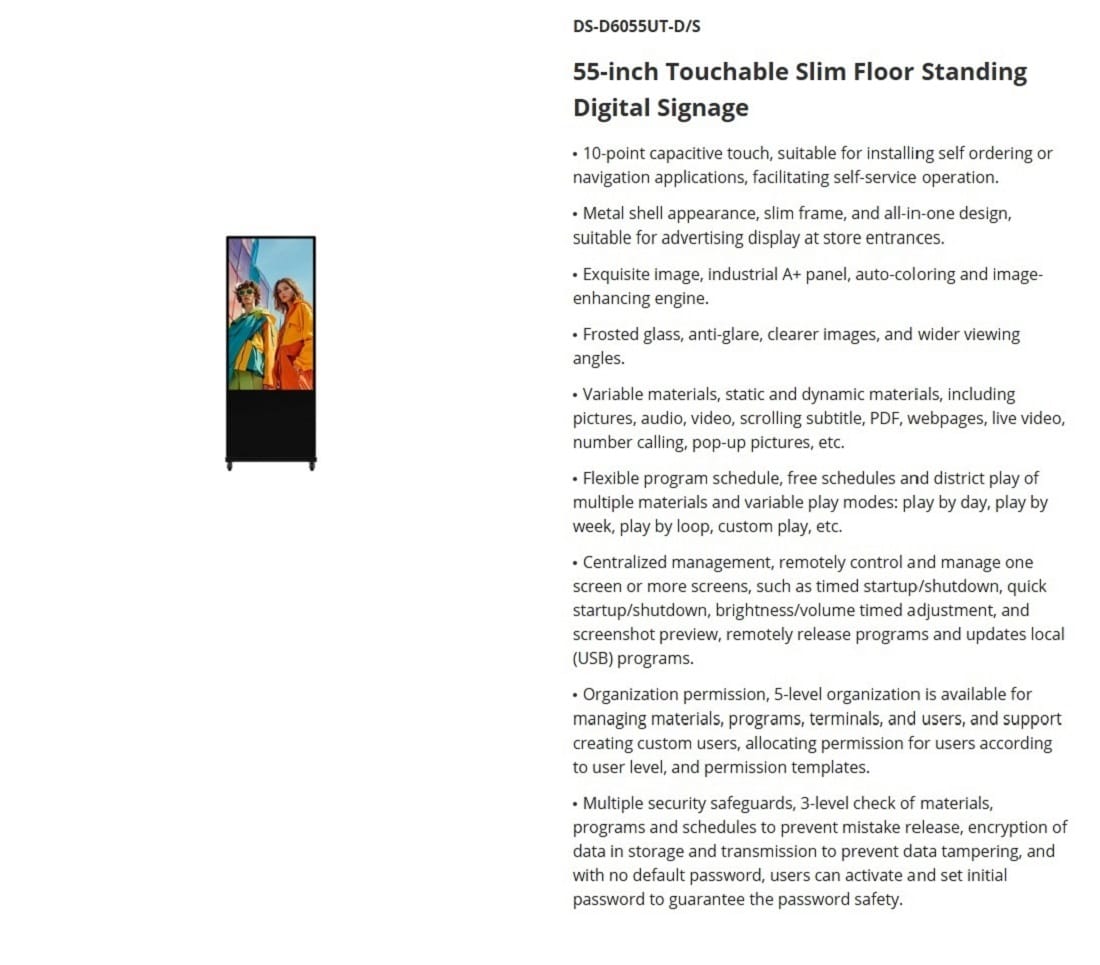
LED backlight
A backlight is a form of illumination used in liquid crystal displays (LCDs). One type of backlight is made by LEDs, which can be either white or RGB (red green blue). White LEDs are used most often in notebooks and desktop screens, and in virtually all mobile LCD screens. RGB LEDs for backlighting are found in high-end color proofing displays such as HP DreamColor LP2480zx monitor or selected HP EliteBook notebooks, as well as newer consumer grade displays such as Dell's Studio series laptops which have an optional RGB LED display.
LED backlighting type
Backlighting is the illumination of a screen e.g. LCD (liquid crystal display). There are several types of backlighting with LEDs, e.g. full array, edge lit.
Edge-LED
Display diagonal
Size of the display for this product, measured diagonally, usually in inches.
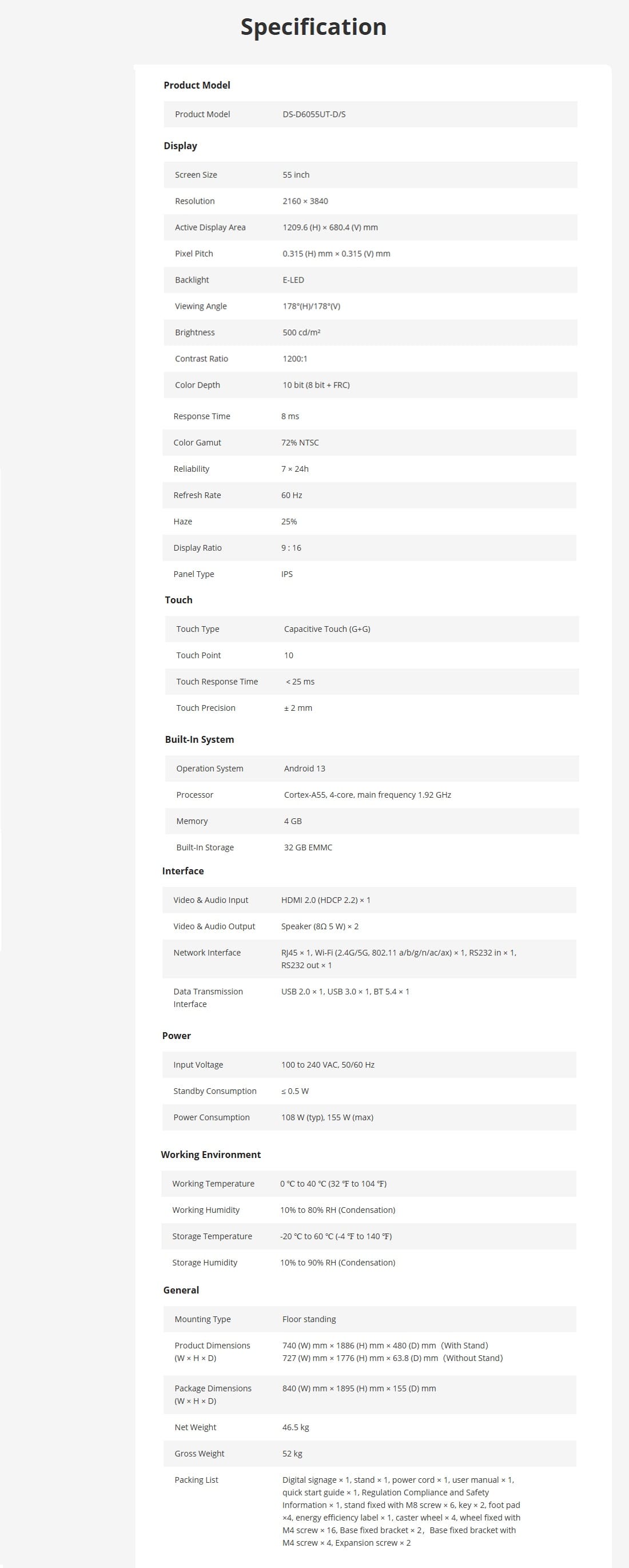
139.7 cm (55")
Display technology
The technology used in the display e.g. plasma, LED.
LED
Display resolution
The number of distinct pixels in each dimension that can be displayed. It is usually quoted as width × height, with the units in pixels: for example, "1024 × 768" means the width is 1024 pixels and the height is 768 pixels. The higher the number of pixels, the sharper the image.
2160 x 3840 pixels
Display brightness
Brightness is the amount of radiating light emitted from the screen. The brightness rating is measured in candellas per square meter, commonly known as 'nits'.
500 cd/m²
HD type
Type of supported High Definition (e.g. Full HD, 4K Ultra HD).
4K Ultra HD
Touchscreen
A screen of a laptop, smartphone, etc., that responds to touch so you can control the interface using your fingers.
Touchscreen technology
Capacitive
Number of simultaneous touchpoints
10
Multi-touch
Native aspect ratio
The aspect ratio is the ratio of the width of an image to its height. The native aspect ratio is the one which the projector/display is particularly designed for. Images shown in native aspect ratio will utilize the entire resolution of the display and achieve maximum brightness. Images shown in other than native aspect ratio will always have less resolution and less brightness than images shown in native aspect ratio.
9:16
Response time
The response time is the time difference between the moment that a source (for example a video card) sends a signal and that equipment (for example a monitor) receives or display the signal. (Used abbreviations: R/F = Rise and Fall.)
8 ms
Contrast ratio (typical)
The difference in light intensity between the brightest white and the darkest black.
1200:1
Viewing angle, horizontal
Maximum horizontal angle at which a display can be viewed with acceptable visual performance.
178°
Viewing angle, vertical
Maximum vertical angle at which a display can be viewed with acceptable visual performance.
178°
Pixel pitch
This is the parameter of a picture tube, which specifies the shortest distance between two dots of the same colour. The principle is: the smaller the dot pitch, the better sharpness of image.
0.315 x 0.315 mm
Active display area (W x H)
680.4 x 1209.6 mm
Display diagonal (metric)
This is the size of the display screen, measured diagonally.
139 cm
Colour depth
10 bit
Native refresh rate
60 Hz
Haze rate
25%
Touch response time
25 ms
RGB colour space
NTSC
Colour gamut
72%
Ports & interfaces
HDMI ports quantity
The number of sockets (ports) for HDMI connections. HDMI (High-Definition Multimedia Interface) is a compact audio/video interface for transferring uncompressed video data and compressed/uncompressed digital audio data from a HDMI-compliant device ("the source device") to a compatible computer monitor, video projector, digital television, or digital audio device. HDMI is a digital replacement for existing analog video standards.
1
HDMI version
2.0
DVI port
Digital Visual Interface (DVI) is a video display interface to connect a video source to a display device, such as a computer monitor.
USB port
The device features a socket into which a USB cable can be plugged.
USB ports quantity
2
USB version
Universal Serial Bus (USB) is an industry standard developed in the mid-1990s that defines the interface used for connection, communication and power supply between computers and electronic devices. Every new version - for example 1.1, 2.0, 3.0 - is much faster than the previous one.
2.0/3.2 Gen 2 (3.1 Gen 2)
USB 3.2 Gen 1 (3.1 Gen 1) Type-A ports quantity
1
Ethernet LAN
An Ethernet LAN (Local Area Network) interface is present, for a wired conection via a cable.
Ethernet LAN (RJ-45) ports
Number of Ethernet LAN (RJ-45) ports (connecting interfaces) in the device. Ethernet LAN (RJ-45) ports allow a computer to connect to the ethernet.
1
Wi-Fi
Popular technology that allows an electronic device to exchange data or connect to the internet wirelessly using radio waves.
Wi-Fi standards
The type of wireless local area network (LAN). It can be ad-hoc, where units in a network communicate peer-to-peer, or Infrastructure, where units communicate with each other via an access point A LAN interconnects computers in a small area e.g. home, school or office.
Built-in speaker(s)
The device contains speaker(s) to produce sound.
Number of built-in speakers
2
RMS rated power
RMS (Root mean square) is a measure of the continuous power required by a device, in particular audio amplifiers and loudspeakers.
5 W
Speaker impedance
8 Ω
Design
Product design
The creation of a plan or convention for the construction of an object or a system.
Kiosk design
Placement supported
Where the product can be placed e.g. indoor/outdoor, horizontal/vertical.
Indoor
Orientation
Vertical
Product colour
The colour e.g. red, blue, green, black, white.
Black
Screen shape
Flat
Performance
Purpose
What the product is used for.
Commercial
Operating hours (hours/days)
24/7
HDCP
High-bandwidth Digital Content Protection (HDCP) is a form of digital copy protection to prevent copying of digital audio and video content as it travels across connections.
HDCP version
2.2
Power
Power consumption (typical)
Amount of power consumed by this model, often expressed in watts (W). Typical values that manufacturers give are power consumption when off, standby/suspended mode, typical use, maximum usage.
108 W
Power consumption (standby)
The amount of electricity that is consumed when the product is on standby.
0.5 W
Power consumption (max)
The maximum amount of power used by the device.
155 W
Energy efficiency class (SDR)
G
Energy consumption (SDR) per 1000 hours
108 kWh
AC input voltage
The voltage of the AC electricity that is inputted into the product.
100 - 240 V
AC input frequency
50/60 Hz
Energy efficiency scale
A to G
Computer system
Computer system
Computer system type
System on Chip (SoC)
Built-in processor
Whether or not a processor is built into the device.
Processor manufacturer
The manufacturer that produced the processor.
ARM
Processor family
A family of processors is a group of processors produced by one company over a short period of time e.g. Intel Pentium processors.
ARM Cortex
Processor model
The model number for the processor in a computer.
A55
Processor architecture
ARM Cortex-A55
Processor frequency
The speed that the microprocessor executes each instruction or each vibration of the clock. The CPU requires a fixed number of clock ticks, or cycles, to execute each instruction. The faster the clocks rate, the faster the CPU, or the faster it can execute instructions. Clock Speeds are usually determined in MHz, 1 MHz representing 1 million cycles per second, or in GHz, 1 GHz representing 1 thousand million cycles per second. The higher the CPU speed, the better a computer will perform.
1.92 GHz
Processor cores
The number of central processing units ('cores') in a processor. Some processors have 1 core, others have 2 (e.g. Intel Core Duo) or more (e.g. the Intel Xeon E7-2850 has 10 cores).
4
Internal memory
A computer's memory which is directly accessible to the CPU.
4 GB
Internal storage capacity
The amount e.g of data which can be stored inside the device.
32 GB
Operating system installed
Type of operating system on a device e.g. IOS on Apple devices, Android for mobile devices.
Android
Operating system version
The version of the operating system used e.g. 4.1, 4.2 for Android.
13
Weight & dimensions
Display width
727 mm
Display depth
63.8 mm
Display height
1776 mm
Width (with stand)
740 mm
Depth (with stand)
480 mm
Height (with stand)
1886 mm
Weight (with stand)
46.5 kg
Packaging data
Package width
The distance from one side of the packaging to the other.
840 mm
Package depth
The distance from the front to the back of the packaging.
155 mm
Package height
The distance from the top to the bottom of the packaging.
1895 mm
Package weight
Weight of the packaged product.
52 kg
Packaging content
Stand included
Stand colour
Black
Stand material
Aluminum/Steel
Remote control included
Component of an electronics device, most commonly a television set, DVD player and home theater systems originally used for operating the device wirelessly from a short line-of-sight distance.
Cables included
AC
Operational conditions
Operating temperature (T-T)
The minimum and maximum temperatures at which the product can be safely operated.
0 - 40 °C
Operating relative humidity (H-H)
10 - 80%
Storage temperature (T-T)
The minimum and maximum temperatures at which the product can be safely stored.
-20 - 60 °C
Storage relative humidity (H-H)
10 - 90%
Other features
Bluetooth
Bluetooth is a low-power radio technology developed to replace the cables and wires currently used to link or connect electronic devices such as personal computers, printers, and a wide variety of handheld devices including mobile phones. Because it uses radio-wave connectivity, a Bluetooth-enabled device has a constant, established connection to whatever browser it uses. This saves the user the trouble of logging on to check for emails or news updates, for example.
Bluetooth version
The type of bluetooth technology in the product e.g. Bluetooth Smart (v4.0).