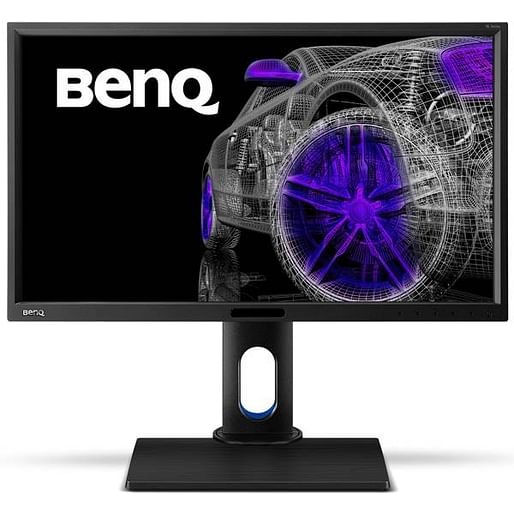
Display diagonal
Size of the display for this product, measured diagonally, usually in inches.
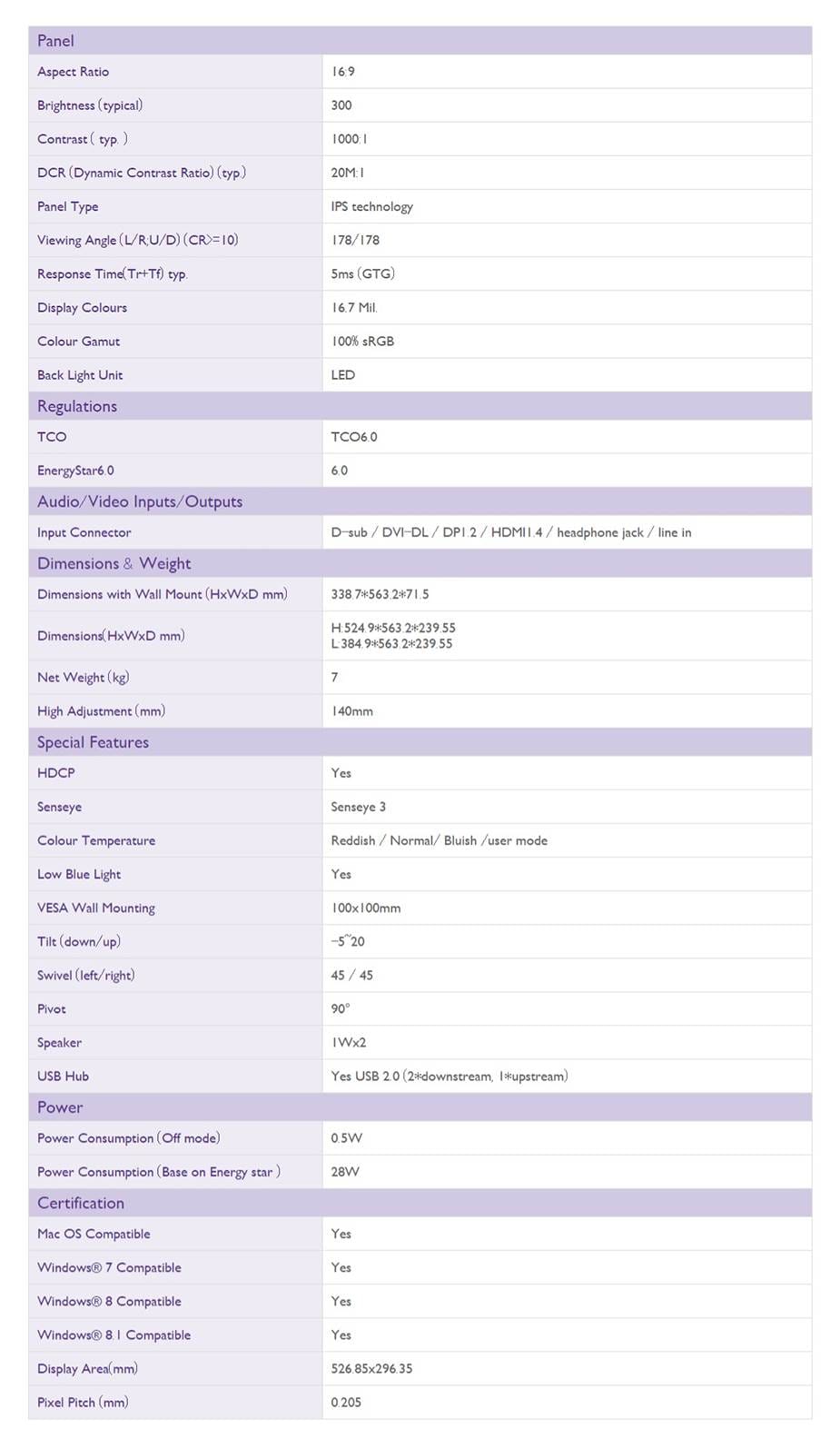
60.5 cm (23.8")
Display brightness (typical)
Display brightness, measured by its Luminance, presented as a figure in candela per square meter (cd/m2). Typical brightness ratings for monitors range from 250 to 350 cd/m2 with a target value of between 80 to 120 cd/m2 being suitable for most displays in a normal viewing environment.
300 cd/m²
Display resolution
The number of distinct pixels in each dimension that can be displayed. It is usually quoted as width × height, with the units in pixels: for example, "1024 × 768" means the width is 1024 pixels and the height is 768 pixels. The higher the number of pixels, the sharper the image.
2560 x 1440 pixels
Native aspect ratio
The aspect ratio is the ratio of the width of an image to its height. The native aspect ratio is the one which the projector/display is particularly designed for. Images shown in native aspect ratio will utilize the entire resolution of the display and achieve maximum brightness. Images shown in other than native aspect ratio will always have less resolution and less brightness than images shown in native aspect ratio.
16:9
Response time
The response time is the time difference between the moment that a source (for example a video card) sends a signal and that equipment (for example a monitor) receives or display the signal. (Used abbreviations: R/F = Rise and Fall.)
5 ms
HD type
Type of supported High Definition (e.g. Full HD, 4K Ultra HD).
Wide Quad HD
Display technology
The technology used in the display e.g. plasma, LED.
LED
Backlight type
LED
Screen shape
Flat
Aspect ratio
The aspect ratio is the ratio of the width of a shape to its height. For example, 4:3 is common for standard displays and 16:9 is the ratio for Widescreen TV.
16:9
Contrast ratio (typical)
The difference in light intensity between the brightest white and the darkest black.
1000:1
Contrast ratio (dynamic)
A property of a display system, defined as the ratio of the luminance of the brightest color (white) to that of the darkest color (black) that the system is capable of producing.
20000000:1
Viewing angle, horizontal
Maximum horizontal angle at which a display can be viewed with acceptable visual performance.
178°
Viewing angle, vertical
Maximum vertical angle at which a display can be viewed with acceptable visual performance.
178°
Display number of colours
16.78 million colors
Panel type
IPS
Pixel pitch
This is the parameter of a picture tube, which specifies the shortest distance between two dots of the same colour. The principle is: the smaller the dot pitch, the better sharpness of image.
0.205 x 0.205 mm
Viewable size, horizontal
The viewable size is often somewhat smaller than the actual size of a monitor, because there is a border around the image.
52.7 cm
Viewable size, vertical
29.6 cm
Colour gamut
100%
Performance
Windows operating systems supported
Windows vesions wich can be used with the device.
Multimedia
Built-in speaker(s)
The device contains speaker(s) to produce sound.
Number of speakers
The quantity of speakers included in/with the product.
2
RMS rated power
RMS (Root mean square) is a measure of the continuous power required by a device, in particular audio amplifiers and loudspeakers.
2 W
Built-in camera
The product has an integrated camera.
Design
Energy Star certified
This indicates that the product is compliant with Energy Star, which is an international standard for energy-efficient consumer products.
Product colour
The colour e.g. red, blue, green, black, white.
Black
Certification
TCO6.0
Ports & interfaces
USB hub version
2.0
USB Type-A downstream ports quantity
3
VGA (D-Sub) ports quantity
Number of VGA (D-Sub) ports (connecting interfaces) in the device. The VGA (D-Sub) connector is a 15 pin connector between a computer and a monitor. It was first introduced in 1987 by IBM.
1
DVI port
Digital Visual Interface (DVI) is a video display interface to connect a video source to a display device, such as a computer monitor.
DVI-D ports quantity
This is the amount of DVI-I interfaces. Digital Visual Interface (DVI) is a video display interface developed by the Digital Display Working Group (DDWG). The digital interface is used to connect a video source to a display device, such as a computer monitor. DVI-D means DVI digital, which means it can only support digital, but not analog.
1
HDMI ports quantity
The number of sockets (ports) for HDMI connections. HDMI (High-Definition Multimedia Interface) is a compact audio/video interface for transferring uncompressed video data and compressed/uncompressed digital audio data from a HDMI-compliant device ("the source device") to a compatible computer monitor, video projector, digital television, or digital audio device. HDMI is a digital replacement for existing analog video standards.
1
DisplayPorts quantity
Number of DisplayPorts. A DisplayPort is a digital display interface developed by the Video Electronics Standards Association (VESA). The interface is primarily used to connect a video source to a display device such as a computer monitor, though it can also be used to carry audio, USB, and other forms of data.
1
Headphone outputs
Number of sockets /ports where headphones are connected.
1
Headphone connectivity
How headphones connect to a device e.g. wirelessly or via a cable and connector.
3.5 mm
Microphone in
The socket where a microphone is connected to the device.
HDCP
High-bandwidth Digital Content Protection (HDCP) is a form of digital copy protection to prevent copying of digital audio and video content as it travels across connections.
Card reader integrated
The device includes a card reader e.g. a card reader in the disk bay of a computer or thin client to permit log-on using smart/pin cards.
Ergonomics
Panel mounting interface
The product can be used wih VESA mounting interfaces.
100 x 100 mm
Cable lock slot
Holes on the edge of devices through which a cable lock can be passed, so the device can be locked to a desk etc.
Cable lock slot type
Kensington
VESA mounting
Height adjustment
14 cm
Pivot
Pivot angle
0 - 90°
Swivelling
Swivel angle range
-45 - 45°
Tilt adjustment
The tilt, which means the angle at which the device is pointing (up or down), can be changed.
Tilt angle range
-5 - 20°
On Screen Display (OSD)
LED indicators
Thin Client
Thin client installed
The product includes a thin client, which is a computer or a computer program which depends heavily on some other computer (its server) to fulfill its computational roles. This is different from the traditional fat client, which is a computer designed to take on these roles by itself. The specific roles assumed by the server may vary, from providing data persistence (for example, for diskless nodes) to actual information processing on the client's behalf.
Power
Energy efficiency class
The energy efficiency of the appliance is rated in terms of a set of energy efficiency classes from A+++ to G on the label, A+++ being the most energy efficient, G the least efficient.
B
Annual energy consumption
The amount of energy used by the product per year.
50 kWh
Power consumption (typical)
Amount of power consumed by this model, often expressed in watts (W). Typical values that manufacturers give are power consumption when off, standby/suspended mode, typical use, maximum usage.
34 W
Power consumption (off)
0.3 W
AC input voltage
The voltage of the AC electricity that is inputted into the product.
96 - 264 V
AC input frequency
47/63 Hz
Operational conditions
Operating temperature (T-T)
The minimum and maximum temperatures at which the product can be safely operated.
5 - 40 °C
Storage temperature (T-T)
The minimum and maximum temperatures at which the product can be safely stored.
-20 - 60 °C
Operating relative humidity (H-H)
20 - 90%
Storage relative humidity (H-H)
10 - 90%
Weight & dimensions
Width
The measurement or extent of something from side to side.
563.2 mm
Depth
The distance from the front to the back of something.
71.5 mm
Height
The measurement of the product from head to foot or from base to top.
338.7 mm
Weight
Weight of the product without packaging (net weight). If possible, the net weight is given including standard accessories and supplies. Please note that sometimes the manufacturer leaves out the weight of accessories and/or supplies.
7 kg
Width (with stand)
563.2 mm
Depth (with stand)
239.6 mm
Height (with stand)
524.9 mm
Packaging data
Cables included
AC,DVI,USB,VGA
Other features
Display
The description of display that can includes display type, resolution, size etc.
LED
On/off switch
The button which is pressed to switch the device on or off.
TV tuner integrated
Device has an in-built TV tuner.
Ethernet LAN
An Ethernet LAN (Local Area Network) interface is present, for a wired conection via a cable.
Bluetooth
Bluetooth is a low-power radio technology developed to replace the cables and wires currently used to link or connect electronic devices such as personal computers, printers, and a wide variety of handheld devices including mobile phones. Because it uses radio-wave connectivity, a Bluetooth-enabled device has a constant, established connection to whatever browser it uses. This saves the user the trouble of logging on to check for emails or news updates, for example.