
Shipping Information
- Unavailable for shipping
- This product is not currently available for purchase
Store Availability
- Unavailable at Bankstown Store
- Unavailable at Castle Hill Store
- Unavailable at Northmead Store
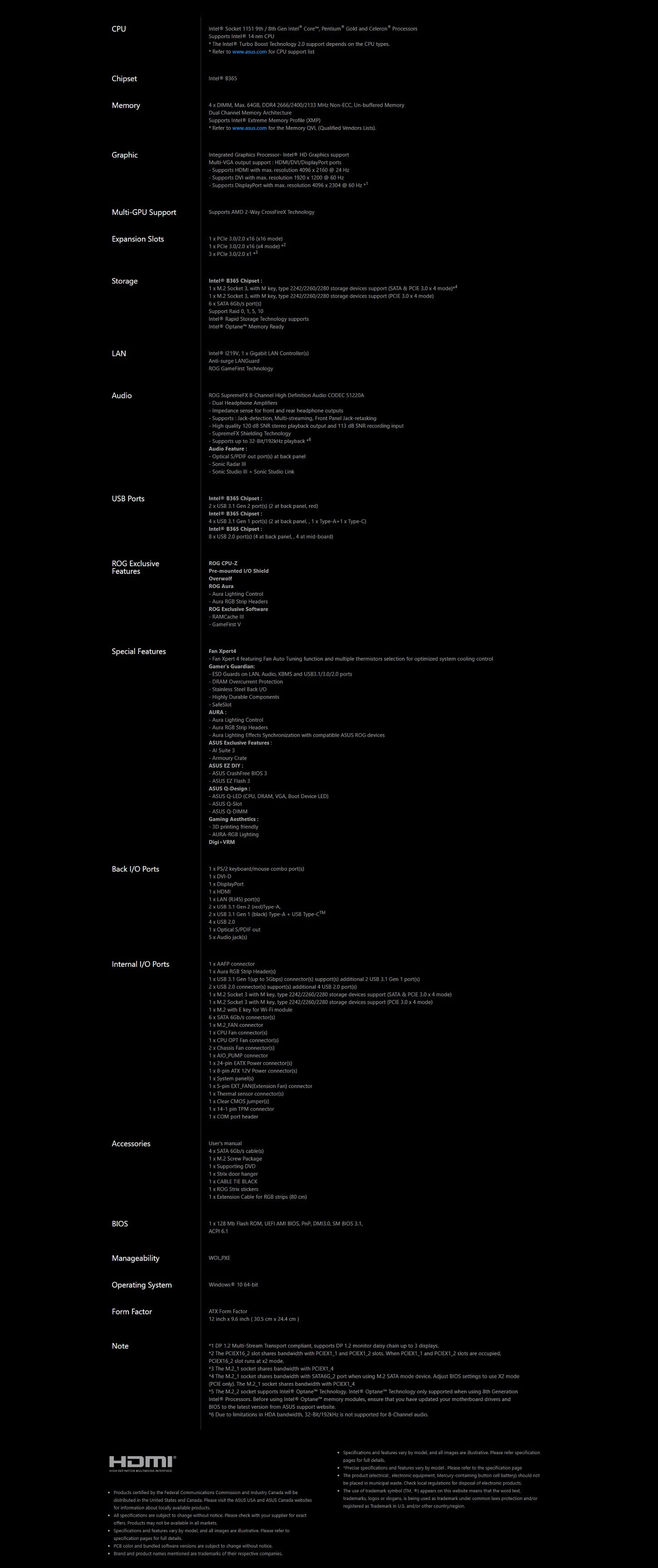
Intel LGA-1151 B365 ATX gaming motherboard with Aura Sync RGB, pre-mounted I/O shield, dual M.2, DisplayPort, HDMI, DVI, SATA 6 Gbps and USB 3.1 Gen 2

| Processor | |
| Processor manufacturer The manufacturer that produced the processor. | Intel |
| Processor socket Mechanical component(s) that provides mechanical and electrical connections between a microprocessor and a printed circuit board (PCB). This allows the processor to be replaced without soldering. | LGA 1151 (Socket H4) |
| Compatible processor series A processor which is compatible with this device, belongs to a 'series' which is part of 'family' e.g Celeron D, Celeron G, Celeron M, or, in some cases, is the same as 'family'. | Intel® Celeron®, Intel® Core™ i3, Intel Core i5, Intel Core i7, Intel® Pentium® |
| Memory | |
| Supported memory types Types of memory which can be used with the product. | DDR4-SDRAM |
| Number of memory slots | 4 |
| Memory slots type A memory slot, also known as a memory socket or RAM slot, is what allows computer memory (RAM) to be inserted into the computer. Depending on the motherboard, there will usually be 2 to 4 memory slots (sometimes more on high-end motherboards). The most common types of RAM are SDRAM and DDR for desktop computers and SODIMM for laptop computers, each having various types and speeds. | DIMM |
| Memory channels | Dual-channel |
| Non-ECC |
 |
| Supported memory clock speeds Memory clock speed is the time it takes for a computer to complete basic operations. It refers to the computer's processing speed and is measured in hertz. It is however not such a reliable measure of a computer's speed as it doesn't take into account other factors like RAM and cache size. | 2133,2400,2666 MHz |
| Maximum internal memory The maximum internal memory which is available in the product. | 64 GB |
| Unbuffered memory |
|
| Storage controllers | |
| Supported storage drive interfaces | Serial ATA III |
| Graphics | |
| Parallel processing technology support Parallel processing technology is the simultaneous use of more than one CPU or processor core to execute a program or multiple computational threads. Ideally, parallel processing makes programs run faster because there are more engines (CPUs or Cores) running it. In practice, it is often difficult to divide a program in such a way that separate CPUs or cores can execute different portions without interfering with each other. Most computers have just one CPU, but some models have several, and multi-core processor chips are becoming the norm. There are even computers with thousands of CPUs. | 2-Way CrossFireX |
| Graphics adapter family | Intel |
| Graphics adapter | HD Graphics |
| Maximum resolution The maximum number of pixels that can be displayed in the image. It is usually quoted as width × height,: for example, "1024 × 768" means the width is 1024 pixels and the height is 768 pixels. | 4096 x 2160 pixels |
| Internal I/O | |
| USB 2.0 connectors The end of a cable with a USB 2.0 connector. USB 2.0 was released in April 2000 (now called "Hi-Speed"), adding higher maximum signaling rate of 480 Mbit/s (effective throughput up to 35 MB/s or 280 Mbit/s), in addition to the "USB 1.x Full Speed" signaling rate of 12 Mbit/s. USB 2.0 connectors are usually colored black. | 2 |
| USB 3.2 Gen 1 (3.1 Gen 1) connectors This is a connector (normally attached to a cable) for USB 3.0. USB 3.0 is the second major revision of the Universal Serial Bus (USB) standard for computer connectivity. First introduced in 2008, USB 3.0 adds a new transfer mode called "SuperSpeed," (distinguishable from USB 2.0 by either the blue colour of the port or the initials SS) capable of transferring data at up to 5Gbit/s—more than ten times as fast as the 480 Mbit/s top speed of USB 2.0. | 1 |
| Number of SATA III connectors Serial ATA (Advanced Technology Attachment) (SATA) is a computer bus interface that connects host bus adapters to mass storage devices such as hard disk drives and optical drives. SATA III (revision 3.x) interface, formally known as SATA 6Gb/s, is a third generation SATA interface running at 6.0Gb/s. The bandwidth throughput, which is supported by the interface, is up to 600MB/s. This interface is backwards compatible with SATA 3 Gb/s interface. | 6 |
| Front panel connector |
|
| ATX Power connector (24-pin) |
|
| Number of EATX power connectors | 1 |
| CPU fan connector |
|
| Number of chassis fan connectors | 2 |
| TPM connector |
|
| 12V power connector |
|
| RGB LED pin header |
|
| Rear panel I/O ports | |
| USB 2.0 ports quantity Number of USB 2.0 ports (connecting interfaces) in the device. USB 2.0 was released in April 2000 (now called "Hi-Speed"), adding higher maximum signaling rate of 480 Mbit/s (effective throughput up to 35 MB/s or 280 Mbit/s), USB 2.0 ports are usually black. | 4 |
| USB 3.2 Gen 1 (3.1 Gen 1) Type-A ports quantity | 2 |
| USB 3.2 Gen 2 (3.1 Gen 2) Type-A ports quantity | 2 |
| Ethernet LAN (RJ-45) ports Number of Ethernet LAN (RJ-45) ports (connecting interfaces) in the device. Ethernet LAN (RJ-45) ports allow a computer to connect to the ethernet. | 1 |
| PS/2 ports quantity The number of PS/2 connectors for keyboards and mice. Its name comes from the IBM Personal System/2. | 1 |
| HDMI ports quantity The number of sockets (ports) for HDMI connections. HDMI (High-Definition Multimedia Interface) is a compact audio/video interface for transferring uncompressed video data and compressed/uncompressed digital audio data from a HDMI-compliant device ("the source device") to a compatible computer monitor, video projector, digital television, or digital audio device. HDMI is a digital replacement for existing analog video standards. | 1 |
| DVI-D ports quantity This is the amount of DVI-I interfaces. Digital Visual Interface (DVI) is a video display interface developed by the Digital Display Working Group (DDWG). The digital interface is used to connect a video source to a display device, such as a computer monitor. DVI-D means DVI digital, which means it can only support digital, but not analog. | 1 |
| DisplayPorts quantity Number of DisplayPorts. A DisplayPort is a digital display interface developed by the Video Electronics Standards Association (VESA). The interface is primarily used to connect a video source to a display device such as a computer monitor, though it can also be used to carry audio, USB, and other forms of data. | 1 |
| S/PDIF out port S/PDIF (Sony/Philips Digital Interconnect Format) is a digital audio interconnect used in consumer audio equipment over relatively short distances. The signal is transmitted over either a coaxial cable with RCA connectors or a fibre optic cable with TOSLINK connectors. |
|
| Digital audio optical out The socket in the device for the digital audio output. The signal is carried via an optical cable with an TOSLINK connector. | 1 |
| Network | |
| Ethernet LAN An Ethernet LAN (Local Area Network) interface is present, for a wired conection via a cable. |
|
| Ethernet interface type | Gigabit Ethernet |
| LAN controller | Intel® I219-V |
| Wake-on-LAN ready |
|
| Wi-Fi Popular technology that allows an electronic device to exchange data or connect to the internet wirelessly using radio waves. |
 |
| Features | |
| Motherboard chipset The chipset connects the microprocessor to the rest of the motherboard. | Intel B365 |
| Audio output channels An audio output channel is an electric circuit which acts as a path for a signal produced by a device. A device may have several audio output channels. | 7.1 channels |
| Component for What this product is used as a part of (component for). | PC |
| Motherboard form factor Design of the motherboard (ATX, BTX etc). | ATX |
| Motherboard chipset family The category of motherboard chipset e.g. Intel, AMD. | Intel |
| Windows operating systems supported Windows vesions wich can be used with the device. | Windows 10 Education x64,Windows 10 Enterprise x64,Windows 10 Home x64,Windows 10 Pro x64,Windows 10 x64 |
| Expansion slots | |
| PCI Express x1 (Gen 3.x) slots | 3 |
| PCI Express x16 (Gen 3.x) slots Places where PCI Express x16 (Gen 3.x) are placed inside and connected to the computer motherboard. | 2 |
| Number of M.2 (M) slots | 2 |
| BIOS | |
| BIOS type The BIOS (Basic Input/Output System) initializes and tests system hardware components, and loads a bootloader or an operating system from a mass memory device. The BIOS additionally provides abstraction layer for the hardware, i.e. a consistent way for application programs and operating systems to interact with the keyboard, display, and other input/output devices. There are several types of BIOS, including the motherboard ROM BIOS, video BIOS, drive controller BIOS, network adapter BIOS, and SCSI adapter BIOS. | UEFI AMI |
| BIOS memory size | 128 Mbit |
| ACPI version | 6.1 |
| Clear CMOS jumper |
|
| System Management BIOS (SMBIOS) version | 3.1 |
| Processor special features | |
| Intel Extreme Memory Profile (XMP) |
|
| Intel® Optane™ Memory Ready |
|
| Weight & dimensions | |
| Width The measurement or extent of something from side to side. | 305 mm |
| Depth The distance from the front to the back of something. | 244 mm |
| Packaging content | |
| Cables included | SATA |
| Drivers included |
|
| Other features | |
| Quick installation guide |
|
| Number of M.2 (E) slots | 1 |
| SKU | 346024 |
| MPN | ROG STRIX B365-F GAMING |
| Brand | Asus |
| Product Condition | Brand New/Unused |
| Product Features | RGB |