
ADATA SU630 240GB 2.5" SATA SSD
Item No:
367920
MPN:
ASU630SS-240GQ-R
$45.84
Limit 2 Per Household
Payment options
Shipping Information
- Unavailable for shipping
- This product is not currently available for purchase
Store Availability
- Unavailable at Bankstown Store
- Unavailable at Castle Hill Store
- Unavailable at Northmead Store
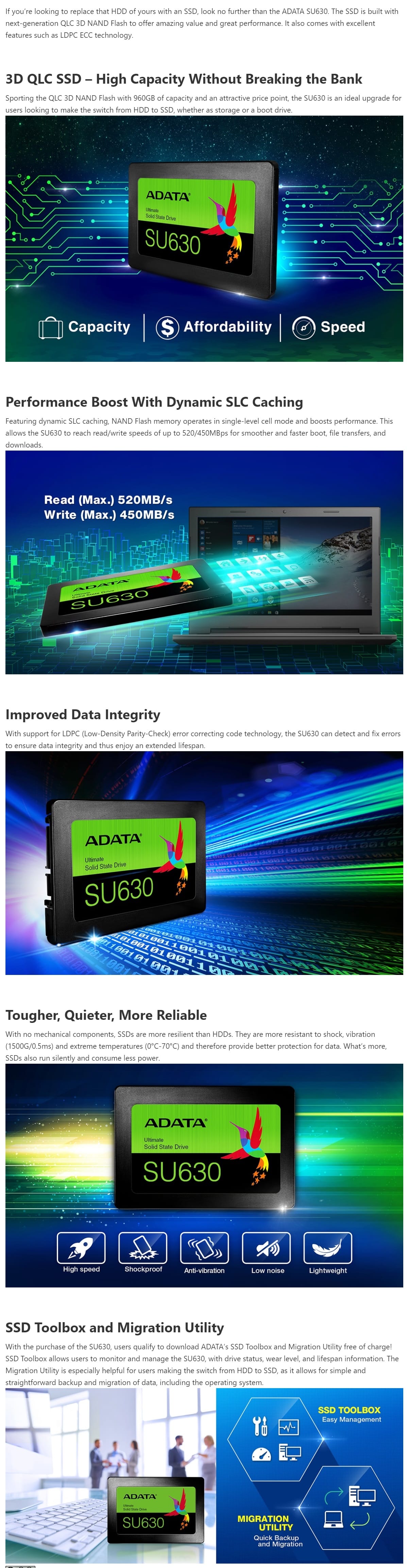
The SSD is built with next-generation QLC 3D NAND Flash to offer amazing value and great performance. It also comes with excellent features such as LDPC ECC technology.
| Features | |
| SSD form factor The size of the solid-state drive, given in inches | 2.5" |
| SSD capacity The Solid State Drive's data storage capacity. | 240 GB |
| Interface Interface ports to connect pieces of equipment. USB (Universal Serial Bus) has become the most popular wired interface to connect peripherals. USB 2.0 supports speeds up to 480 Mbit/s (USB 1: 12 Mbit/s). The interface FireWire is also known as the IEEE 1394 standard. Enhanced IDE (EIDE)is sometimes referred to as Fast ATA, Fast IDE or ATA-2. | Serial ATA |
| Memory type Type of memory in the device e.g. DDR3, SRAM (Static RAM). | QLC 3D NAND |
| Component for What this product is used as a part of (component for). | PC/notebook |
| Hardware encryption |
 |
| Data transfer rate Rate at which data can be transferred. Usually expressed in units per second. May vary with network configurations. | 6 Gbit/s |
| Read speed The speed at which a device can read data. | 520 MB/s |
| Write speed The speed at which a device can write data. | 450 MB/s |
| Random read (4KB) | 30000 IOPS |
| Random write (4KB) | 65000 IOPS |
| S.M.A.R.T. support |
 |
| ECC ECC means Error Correction Code, and it is memory that is able to detect and correct some memory errors without user intervention. |
|
| Mean time between failures (MTBF) Statistical model used to indicate product/mechanism reliability; expressed in hours and percentage of duty cycle. This number (in hours) does not indicate the mean time before failure for a single unit/mechanism. | 1500000 h |
| Windows operating systems supported Windows vesions wich can be used with the device. |
|
| Mac operating systems supported Mac operating systems e.g. OS X can be used with the device. |
|
| Linux operating systems supported 8 RT. Linux (9.4, 9.5), Red Hat Enterprise Linux 5.0 (supported with a pre-built package); SUSE Linux (10.3, 11.0, 11, 11.1, 11.2), Fedora (9, 9.0, 10, 10.0, 11.0, 11, 12, 12.0), Ubuntu (8.04, 8.04.1, 8.04.2, 8.10, 9.04, 9.10, 10.04), Debian (5.0, 5.0.1, 5.0.2, 5.0.3) |
|
| RoHS compliance The Restriction of Hazardous Substances (RoHS) Directive aims to restrict certain dangerous substances commonly used in electrical and electronic equipment. Any RoHS compliant product is tested for the presence of Lead (Pb), Cadmium (Cd), Mercury (Hg), Hexavalent chromium (Hex-Cr), Polybrominated biphenyls (PBB), and Polybrominated diphenyl ethers (PBDE). PBB and PBDE are flame retardants used in several plastics. For Cadmium and Hexavalent chromium, there must be less than 0.01% of the substance by weight at raw homogeneous materials level. For Lead, PBB, and PBDE, there must be no more than 0.1% of the material, when calculated by weight at raw homogeneous materials. Any RoHS compliant component must have 100 ppm or less of mercury and the mercury must not have been intentionally added to the component. In the EU, some military and medical equipment are exempt from RoHS compliance. |
|
| Operational conditions | |
| Operating temperature (T-T) The minimum and maximum temperatures at which the product can be safely operated. | 0 - 70 °C |
| Storage temperature (T-T) The minimum and maximum temperatures at which the product can be safely stored. | -40 - 85 °C |
| Operating relative humidity (H-H) | 5 - 95% |
| Operating shock Environmental requirements for optimal protection from impact in operating mode | 1500 G |
| Vibration resistance | 20 G |
| Weight & dimensions | |
| Width The measurement or extent of something from side to side. | 69.8 mm |
| Depth The distance from the front to the back of something. | 100 mm |
| Height The measurement of the product from head to foot or from base to top. | 6.8 mm |
| Weight Weight of the product without packaging (net weight). If possible, the net weight is given including standard accessories and supplies. Please note that sometimes the manufacturer leaves out the weight of accessories and/or supplies. | 47.5 g |
| Packaging data | |
| Package type The type of product package e.g. box. | Hanging box |
| SKU | 367920 |
| MPN | ASU630SS-240GQ-R |
| Brand | ADATA |
| Assembled to Order | No |
| Shipping Latency | None |
| Display In Stock In Frontend | No |
| Product Condition | Brand New/Unused |
| Drive Form Factor | 2.5" |
| Connection Interface | SATA |
| Stock Availability | Available for Shipping |
| Warranty Period | 3 Years Warranty |
| Warranty Contact | https://www.adata.com/ |